The most useful way to think about influencer marketing careers in the UK is this. You’re not looking at a side-hustle niche any more. You’re looking at an industry that grew from £4.8 billion in 2016 to an estimated £15 billion by 2025, while 80% of UK marketers either maintained or increased influencer spend in 2025, according to Socially Powerful’s UK influencer marketing statistics roundup.
That changes the career question completely.
Most beginners still frame the space too narrowly. They assume the only route is becoming a creator and hoping brand deals appear. In practice, the creator economy runs on structured commercial roles across brands, agencies, and creator businesses. Someone has to shortlist talent, negotiate briefs, track links, chase usage rights, report performance, manage disclosure rules, and explain to finance why one campaign deserves another budget line.
That “someone” is where many of the best influencer marketing careers are built.
I’ve seen ambitious newcomers make the same mistake repeatedly. They focus on aesthetics before operations. They learn editing before reporting. They talk about “passion for social” before they can explain how a campaign moved from awareness to conversion. Brands don’t hire for enthusiasm alone. They hire people who can organise chaos, protect margin, and turn creator activity into measurable business outcomes.
Practical rule: If you can connect creators to revenue, you become hard to replace.
The Booming World of Influencer Marketing Careers
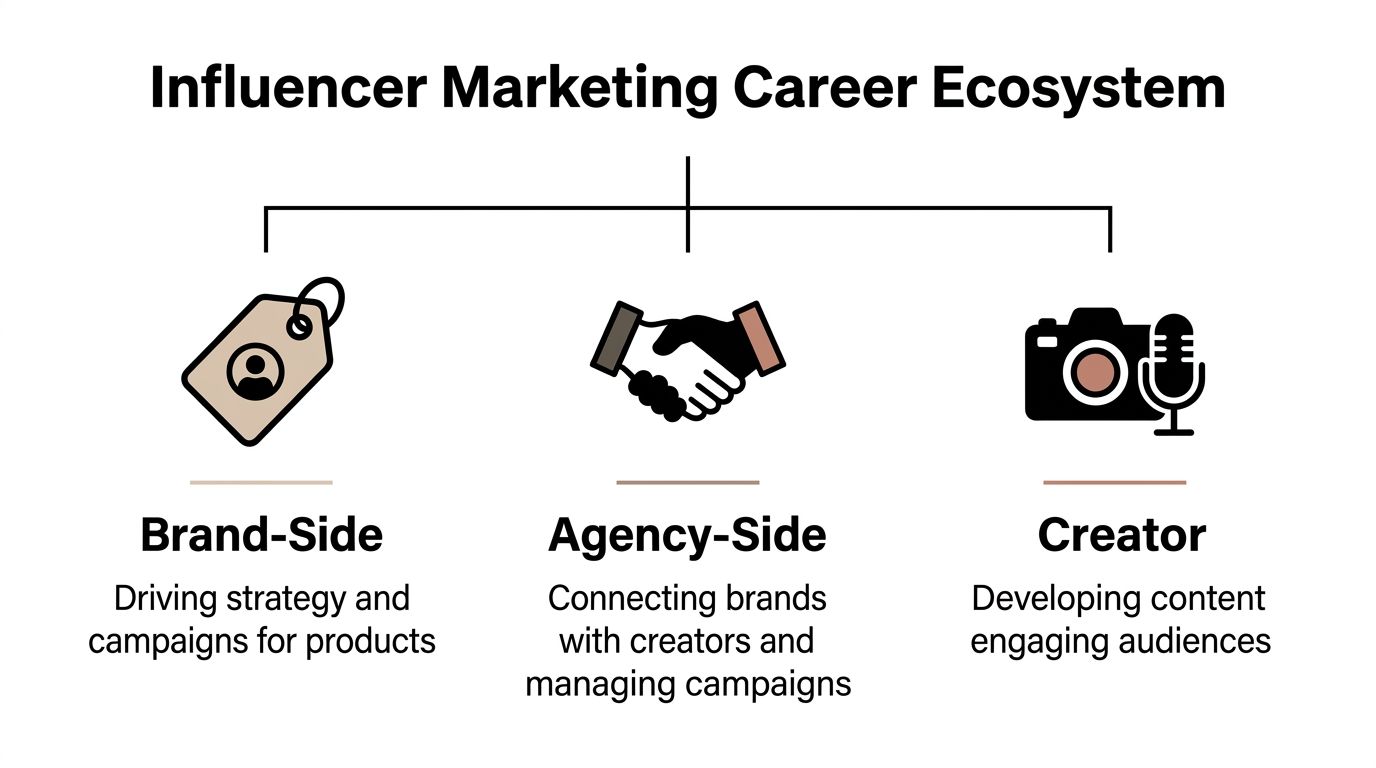
Influencer marketing careers now sit across three core pillars. Brand-side, agency-side, and creator-side. Each pillar needs different instincts, different working styles, and different definitions of success.
On the brand side, you’re building one company’s programme. You care about repeatable performance, internal alignment, and how influencer activity fits wider marketing. On the agency side, you’re managing multiple clients, multiple sectors, and multiple moving parts at once. On the creator side, you’re treating a person or content brand like a media business, with commercial partnerships, operations, and long-term positioning.
That distinction matters because the industry only looks chaotic from the outside.
Why this stopped being a hobby sector
The sector has matured because money, process, and accountability moved in. Once brands started treating creators as a budget line rather than an experiment, proper jobs followed. Campaigns now need planners, managers, analysts, coordinators, talent specialists, and people who can handle compliance without slowing the work down.
The result is a more serious employment market than many outsiders realise.
A beginner often asks, “Should I try to become an influencer?” A better question is, “Where in the commercial engine do I fit?” If you enjoy negotiation and client handling, agency work may suit you. If you like depth, category knowledge, and building one programme over time, brand-side roles usually fit better. If you’re closest to content and personal brand development, creator operations can be the sharpest entry point.
How the three sides depend on each other
These paths aren’t isolated. They feed each other.
Brands need creators to reach audiences in a more trusted format than standard ads.
Agencies translate brand goals into creator campaigns that can run at scale.
Creators and their teams supply the audience relationship, content, and cultural relevance that make campaigns work.
The best professionals in influencer marketing careers understand all three. Even if you start on one side, your judgement improves fast when you learn how the other two operate. A brand manager who understands creator workloads writes better briefs. An agency executive who understands internal brand pressure reports better. A creator manager who understands procurement and attribution negotiates smarter.
That’s why this field rewards commercial awareness more than clout.
Mapping The Career Landscape Brand Agency and Creator
A simple analogy helps. Think of influencer marketing like the film industry. The brand is the studio funding the project. The agency is the production partner assembling the cast and making the schedule work. The creator business is the talent side, where the face on screen is backed by planning, negotiation, and operations.
Each path can build a strong career. The difference is what kind of pressure you want to live with every day.
Brand-side work
In-house roles are usually cleaner in scope and deeper in context. You spend more time learning one customer, one product set, one approval chain, and one commercial target. That sounds simpler. It often isn’t. Internal alignment can be slow, and you’ll need to persuade stakeholders who still think influencer work is mostly gifting and guesswork.
Typical work includes:
Strategy ownership: Building creator plans around launches, seasonal pushes, or always-on growth.
Cross-team coordination: Working with paid social, PR, ecommerce, legal, and customer teams.
Performance reporting: Explaining what happened in language leadership values.
Brand-side suits people who like consistency and long-term optimisation. If you want to improve a programme quarter after quarter rather than jump between clients, this route makes sense.
Agency-side work
Agency roles are faster, messier, and often better for learning quickly. You’ll work across several brands, sectors, and creator mixes. That gives you reps. It also gives you inboxes full of changing timelines, client opinions, and creator negotiations happening at once.
You’ll usually learn more about process under pressure here than anywhere else.
According to Mediabistro’s guide to influencer marketing jobs, an Influencer Marketing Manager in the UK typically oversees 10 to 30 active creator relationships simultaneously, which tells you a lot about the operational load in these roles. That volume forces discipline. You can’t survive on memory and good intentions. You need systems.
If you want a closer look at how agencies structure creator programmes, this influencer management agency overview is useful for understanding how campaign handling, talent coordination, and reporting usually fit together.
Agency work rewards people who can switch from creative judgement to spreadsheet discipline in the same hour.
Creator-side work
The creator-side path is misunderstood because people see the content and miss the business behind it. Successful creators often rely on someone to manage inbound opportunities, negotiate deliverables, check contract terms, schedule production, and keep partnerships aligned with audience trust.
That can mean working directly for a creator, for a talent management company, or in a hybrid operations role.
This environment suits people who are commercially sharp but more talent-facing than client-facing. You need diplomacy. Creators care about brand fit, workload, tone, and reputation. A bad deal isn’t just a weak campaign. It can damage the audience relationship that makes the whole business valuable.
Which environment fits you
Choose based on your working style, not on what sounds glamorous.
Environment | Best fit for | Common pressure point | What success looks like |
|---|---|---|---|
Brand-side | People who like depth and internal strategy | Slow approvals and stakeholder buy-in | A repeatable programme tied to business goals |
Agency-side | People who enjoy pace and variety | Managing multiple clients and deadlines | Smooth delivery across many campaigns |
Creator-side | People who like talent development and dealmaking | Protecting trust while growing revenue | Strong partnerships without damaging the creator brand |
Exploring Key Roles Salaries and Progression Paths
Titles in influencer marketing often hide more than they clarify. A coordinator at one agency may be doing the work of an executive elsewhere. A manager title can mean full budget ownership, or it can mean chasing approvals and updating trackers. Judge the role by four things: what decisions it owns, what budget it touches, what metrics it reports, and how close it sits to revenue.
For career planning, two roles are especially useful because they sit on the commercial side of the industry and have clearer expectations: Influencer Marketing Manager and Creator Economy Analyst.
What an Influencer Marketing Manager does
An Influencer Marketing Manager runs the middle of the machine. The job combines creator sourcing, negotiation, briefing, delivery, reporting, and internal stakeholder management. In practice, this is the person who keeps a campaign commercially sound while still keeping creators willing to work with you again.
Mediabistro’s career guide notes that UK Influencer Marketing Manager roles commonly ask for 3 to 5 years’ experience and sit around £45k to £75k, with platform fluency in tools such as Grin or Traackr often expected alongside relationship management and ROI tracking: Mediabistro’s career guide.
That salary band makes sense. Good managers do far more than organise posts.
Typical responsibilities include:
Creator selection: matching audience fit, brand safety, content quality, and campaign objective
Rate negotiation: agreeing fees, usage rights, whitelisting terms, timelines, and revision limits
Campaign delivery: managing briefs, contracts, approvals, product sends, posting schedules, and reporting
Performance ownership: turning campaign results into a case for more budget, better creator mix, or a different channel split
The trade-off in this role is constant. Push too hard on cost and you damage creator goodwill. Stay too loose on scope and margin disappears. The best managers know where flexibility helps and where it becomes expensive.
The analyst role brings discipline to creator investment
A Creator Economy Analyst sits closer to forecasting, vetting, and measurement. This role is less visible from the outside, but strong teams depend on it. Analysts pressure-test audience quality, compare creators across platforms, build reporting views clients can trust, and flag where performance is being overstated.
The same guide notes that more experienced UK analyst roles can reach £60k to £95k. It also describes the technical side of the job, including dashboard work, platform knowledge, and fraud-risk checks such as fake follower analysis. In plain terms, analysts separate creator popularity from creator value.
This role suits people who enjoy evidence more than pitch theatre. You need to be comfortable telling a team that the creator everyone likes is overpriced, poorly matched, or unlikely to convert.
If you want to understand the creator-side revenue logic better, especially for video-led talent, Vidito's guide to YouTube earnings is worth reading because it helps decode how creator businesses think about monetisation beyond a one-off sponsorship.
Career benchmarks at a glance
Role Title | Experience Level | Average Salary Range (UK, 2026) | Core Responsibilities |
|---|---|---|---|
Influencer Marketing Manager | Mid-level, typically after several years in campaign execution | £45k to £75k | Manage creator relationships, negotiate deals, run campaigns, track ROI, report performance |
Creator Economy Analyst | Mid to senior, typically with stronger analytics depth | £60k to £95k | Vet creators, analyse platform and campaign data, identify fraud risk, build dashboards, support investment decisions |
Campaign Coordinator | Entry-level to early career | Qualitative only | Handle timelines, product sends, approvals, creator follow-up, status tracking |
Creator Relationship Manager | Mid-level | Qualitative only | Build long-term creator trust, manage negotiations, maintain retention and communication quality |
Influencer Executive | Entry-level to early mid-level | Qualitative only | Support outreach, list building, briefing, reporting prep, campaign administration |
What progression really looks like
Progression in this field follows ownership, not glamour. People move up when they reduce risk, protect margin, and make better decisions with less supervision.
A common path looks like this:
Coordinator or executive stage
You learn campaign process, admin discipline, and how to keep details from slipping.Manager stage
You own creator relationships, delivery quality, budget trade-offs, and performance reporting.Strategist, lead, or head-of level
You decide channel mix, creator investment logic, testing priorities, measurement standards, and how to defend the programme to senior stakeholders.
I have seen junior hires stall because they chased trend knowledge instead of commercial judgment. The faster route is simpler. Become the person who can explain why a creator is worth the fee, what result the brand should expect, and what to change when performance misses target.
The Essential Skills and Tools You Need to Master
Most newcomers ask what software they should learn first. That’s the wrong first question. Tools matter, but they only help if you understand the work they’re meant to support.
The stack has three layers. Soft skills, hard skills, and platform fluency. Miss one layer and your career stalls early.
Soft skills that actually affect outcomes
Communication is obvious, yet its common definition is too loose. In this industry, communication means writing a brief that doesn’t create five rounds of confused creator questions. It means handling awkward deadline conversations without damaging the relationship. It means updating a client before they ask.
Relationship building also matters more than people admit. Many campaigns don’t fail because the concept was poor. They fail because trust broke down somewhere between first outreach and final posting.
Focus on these first:
Negotiation: You need to protect budget, deliverables, and usage rights.
Expectation setting: Clear scope early prevents expensive confusion later.
Calm follow-up: People remember the professional who keeps things moving without panic.
Hard skills that move you beyond junior level
Failure in these areas exposes weaker candidates. If you can’t read a report, assess creator quality, or organise campaign data properly, you’re stuck in admin support for too long.
The practical hard skills include:
Spreadsheet competence: Excel or Google Sheets is still the operating system of campaign reality.
Reporting logic: You need to understand engagement, conversions, link tracking, code use, and what each metric can and can’t tell you.
Commercial basics: Budget handling, contract awareness, usage permissions, and disclosure rules all matter.
A lot of people try to skip this layer because it’s less glamorous than creator outreach. That’s a mistake. The careers that last are built on commercial reliability.
Platform and tool fluency
You don’t need to master every platform on day one, but you do need to understand how different environments change campaign planning. TikTok, Instagram, YouTube, and affiliate-style creator work don’t behave the same way. The content rhythm, creator workload, approval expectations, and reporting setup can all differ.
Useful tools depend on the role, but these usually appear quickly:
Management platforms: Grin, CreatorIQ, Traackr, Aspire
Reporting tools: Tableau, GA4, native platform analytics
Workflow systems: Notion, Airtable, Asana, Monday, shared drives with version control
Learn one creator CRM deeply, one reporting workflow properly, and one clean way to manage briefs. That’s more valuable than shallow familiarity with ten tools.
A practical entry sequence
If you’re starting from scratch, don’t overcomplicate it.
Build adjacent experience first by helping with social coordination, outreach support, community management, or creator admin.
Create a small proof-of-work portfolio with sample briefs, creator lists, mock campaign plans, and reporting templates.
Learn ASA and contract basics well enough to avoid sounding careless in interviews.
Practise platform analysis by reviewing real creators and writing down why you would or wouldn’t shortlist them.
Prepare operating examples so you can explain how you’d handle late content, mismatched deliverables, or weak reporting.
That progression gets you closer to hireable than another “social media trends” certificate.
Your Practical Roadmap to Break Into the Industry
The cleanest entry point into influencer marketing careers usually isn’t glamorous. It’s support work. Admin-heavy, process-heavy, often under-credited support work. That’s not bad news. It’s where people learn how campaigns function.
A 2025 UK Influencer Marketing Benchmark Report found that 68% of aspiring professionals start in support roles like virtual assistants, yet only 22% transition to full-time manager positions within 12 months, largely because they lack a clear roadmap and knowledge of UK-specific contract and ASA guidelines, according to Upwork’s summary of the benchmark finding.
That gap is exactly why talented people stay stuck. They do useful work, but they never convert that experience into a commercial story an employer wants to buy.
Start where the work is real
If you can get a role titled Influencer Marketing Assistant, great. If not, don’t wait for the perfect title. Social media coordinator, partnerships assistant, account executive, creator outreach freelancer, and ecommerce marketing assistant can all be credible starting points if the work touches creators, reporting, or campaign logistics.
The aim at this stage is simple. Get close to the machinery.
Look for chances to own practical tasks such as:
Outreach handling: Drafting messages, tracking replies, and identifying who needs follow-up.
Brief support: Turning loose campaign ideas into clean deliverables and deadlines.
Reporting prep: Pulling screenshots, links, codes, and performance notes into one place.
Build a portfolio before someone asks for one
A weak beginner CV says, “Interested in influencer marketing and social media culture.” A strong one shows operating ability.
Your portfolio doesn’t need paid clients to be convincing. It can include:
A mock influencer shortlist for a restaurant launch
A sample campaign brief with deliverables and approval timings
A creator vetting sheet with notes on fit, risk, and content quality
A reporting template showing how you’d summarise outcomes
This kind of portfolio proves you understand the work beyond aesthetics.
If you don’t have campaign experience yet, show decision-making. Hiring managers often care more about how you think than about whether you’ve already worked on a famous brand.
Network like an operator, not a fan
A lot of people approach industry networking the wrong way. They send vague messages asking to “pick your brain”. Don’t do that. Write like someone who understands people are busy.
Try this instead:
Identify agency leads, brand managers, and creator operations people in the UK market.
Comment intelligently on their work or posts when you have something useful to add.
Ask a precise question about process, not a broad request for career advice.
Share a relevant sample, such as a creator shortlist or reporting template, if appropriate.
That approach feels professional because it is professional.
A useful primer on career presentation is this video, especially if you’re preparing to pitch yourself more clearly in applications and outreach.
Prepare for the interview you’re actually going to get
Most entry interviews won’t test theory. They’ll test judgement. Expect practical questions.
Common examples include:
How would you handle a creator who missed a deadline?
A strong answer balances relationship management with campaign requirements. Don’t go straight to blame.How would you choose micro-creators for our brand?
Show a selection method. Audience fit, content quality, relevance, consistency, and likely conversion intent matter.How would you report results to a client or manager?
Focus on business relevance, not vanity metrics alone.What would you check before sending a contract or brief?
Mention deliverables, timeline, usage rights, disclosure expectations, and approval process.
Think long-term from day one
The people who last in this field don’t just chase “getting in”. They build a solid foundation early. That means learning regulation, understanding attribution, and not basing your whole career on trend fluency.
The industry changes fast. A platform feature shifts. A disclosure standard tightens. A client asks tougher questions about return. If your value rests only on knowing which sounds are trending, you’re exposed. If your value rests on judgement, structure, and measurable outcomes, you can keep moving up.
How to Advance and Build a Sustainable Career
Early progression in influencer marketing careers comes from execution. Long-term progression comes from proof. If you want to move from coordinator to manager, or from manager to lead, you need to show that your work produces business clarity, not just campaign activity.
That sounds obvious, but a lot of careers stall at the same point. Someone becomes excellent at running briefs, chasing creators, and keeping launches on track. Then they hit a ceiling because they can’t yet explain which creator mix was worth funding again and why.
Why attribution protects your career
A 2025 Opinium survey for the Influencer Marketing Trade Body found that 41% of UK agency managers quit within two years due to pressure from unmeasured ROI, as reported in LiveChat’s digital marketing niches article. That’s one of the clearest warnings in the sector.
People don’t usually burn out only because the work is busy. They burn out because the pressure is fuzzy. If every campaign feels subjective, every budget conversation becomes political. If you can’t prove value, you end up defending effort instead of outcomes.
Move from delivery to strategy
Advancement usually requires a shift in how you frame your own work.
At junior level, you say:
We sourced creators
We got content live
We delivered on time
At senior level, you say:
We prioritised this creator mix because it matched the purchase journey
We changed the brief to improve content usability
We shifted budget based on what converted, not what looked impressive
That’s a different kind of thinking. It’s commercial judgement.
Build a reputation people can understand quickly
A lot of strong professionals undersell themselves because their online presence looks generic. If you want better opportunities, your positioning needs to make your value obvious. One practical resource on that front is this guide on how to improve your LinkedIn profile, especially if your current profile reads more like a social enthusiast than a commercial operator.
Make sure your profile signals things like:
Category familiarity: Beauty, hospitality, DTC, ecommerce, food, lifestyle
Type of ownership: Outreach, campaign management, reporting, strategy, creator partnerships
Evidence of judgement: Brief examples of projects, systems improved, or reporting responsibilities
Sustainability is a skills issue, not just a resilience issue
People talk about burnout in vague terms. In this field, burnout often has specific causes.
Common ones include:
unclear success metrics
poor workflow systems
weak boundary-setting with clients or creators
shallow legal and compliance understanding
taking on strategic responsibility without attribution confidence
The most sustainable careers in this industry are built by people who make the work easier to understand, easier to measure, and harder to dispute.
If you freelance or work creator-side, sustainability also means handling the less visible side of the job properly. Contracts, invoicing discipline, disclosure compliance, and a realistic workload all matter. Ambition helps. Structure keeps the ambition alive.
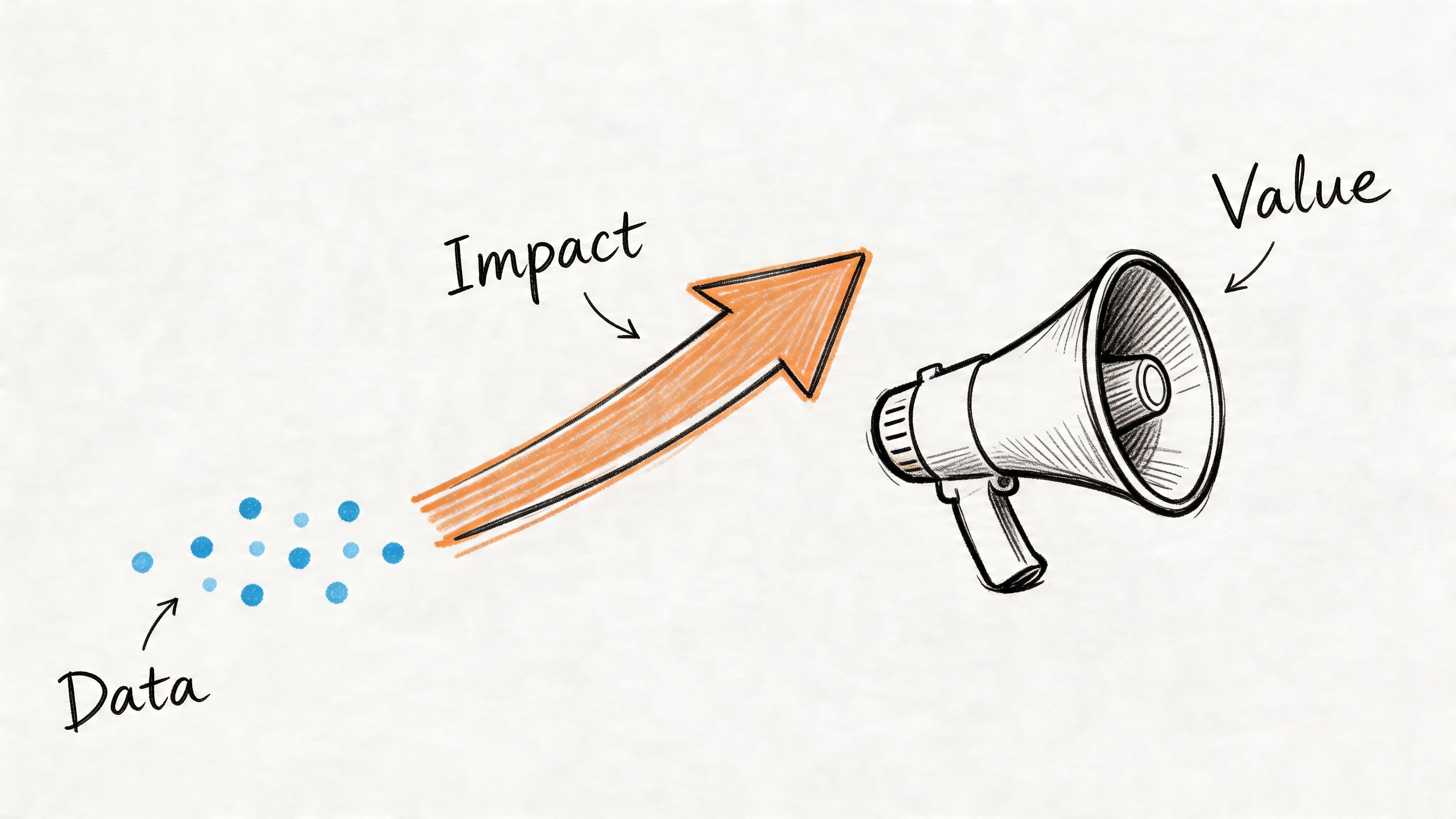
Measuring and Communicating Your Impact to Prove Value
A lot of people in influencer marketing careers still get trapped by vanity reporting. They show likes, comments, views, and happy screenshots, then wonder why leadership hesitates to expand budget. Creative output matters. Business translation matters more.
If you want to become senior, you need to communicate impact in a language that finance teams, founders, and clients can act on.
Start with the right measurement mindset
The most useful question after a campaign isn’t “Did people engage?” It’s “What happened because this ran?” Depending on the business, that might mean sales, bookings, email sign-ups, code use, or qualified traffic.
The reporting stack usually works best when it combines a few layers:
Reach and engagement data to show whether content earned attention
Tracked links and promo codes to connect creator activity to action
Campaign context explaining what type of creator and content drove results
The exact tools differ by company, but the principle is consistent. You need attribution mechanisms that follow performance past the post itself.
The metrics that actually help career growth
The professionals who advance fastest don’t drown stakeholders in dashboards. They simplify.
A strong campaign recap often answers these questions:
Question | What you should show |
|---|---|
Did the right people see this? | Audience fit, content relevance, useful reach indicators |
Did they act? | Link clicks, code redemptions, bookings, conversions |
Was the spend justified? | Cost efficiency, revenue contribution, repeatability |
What should change next time? | Better creator mix, improved brief, stronger offer, different timing |
When you present data this way, you stop sounding like a campaign coordinator and start sounding like someone who can manage budget.
A useful reference point for that measurement discipline is this breakdown of how to measure influencer marketing with the metrics that actually matter. It’s especially relevant if you’re trying to move from surface-level campaign reporting into clearer attribution logic.
What the future rewards
This part of the industry is getting more professional, not less. AI will keep changing how teams shortlist creators, organise outreach, and summarise performance. But AI won’t remove the need for judgement. It will raise the standard for it.
The best long-term opportunities in influencer marketing careers sit with people who can combine three things:
creative understanding
commercial reporting
operational discipline
That mix is rare enough to stay valuable.
Good reporting doesn’t just prove the campaign worked. It proves you know why it worked, which is what earns trust for the next budget, the next promotion, and the next level of responsibility.
The Future Is Bright Your Place in the Creator Economy
If you’re serious about influencer marketing careers, the smartest move is to stop thinking only about visibility and start thinking about infrastructure. This field needs people who can manage relationships, shape strategy, interpret results, and keep campaigns commercially sound.
That creates room for several kinds of ambition. You can build an agency career. You can go in-house and own a programme. You can work on the creator side and help turn talent into a durable business. Each route is legitimate. Each rewards competence faster than hype.
Practical questions people still ask
A few short answers help close the gap.
Should you learn AI tools now?
Yes. Use them to speed up research, admin, and workflow support, but don’t outsource judgement. A helpful starting point is this look at how AI is changing influencer marketing in 2026.Can creator-side experience help if you want a brand role later?
Absolutely. If you understand how creators price work, plan content, and protect audience trust, you’ll brief better and negotiate more realistically.Should you think about revenue diversity early?
If you’re leaning toward creator-side work, yes. This white label guide for content creators is useful because it broadens how you think about monetisation beyond one-off brand deals.
The opportunity here is real. The people who do best usually aren’t the loudest. They’re the ones who learn the business side early, stay adaptable, and make themselves useful in ways a team can measure.
Frequently Asked Questions About Influencer Careers
Do I need a university degree for influencer marketing careers
No. A degree can help, especially in marketing, media, business, or analytics, but it isn’t the deciding factor. Employers usually care more about judgement, organisation, communication, platform understanding, and proof that you can handle campaign execution or reporting responsibly.
Can I start part-time
Yes. Many people begin through freelance outreach, creator support, social media assistance, or campaign admin. Part-time work can be a strong entry route if you treat it like professional experience and document what you’ve done.
What’s the single most important skill for a beginner
Commercial clarity. You need to understand that this isn’t just content culture. It’s a business function. If you can explain creator choices, keep work organised, and connect activity to outcomes, you’ll progress faster than someone who only knows trends.
Is it better to start brand-side or agency-side
Neither is automatically better. Agency-side usually accelerates learning because you see more campaign variety. Brand-side often gives more depth and stakeholder exposure. Choose based on how you work best.
Can creators move into industry roles
Definitely. Creators who understand briefs, partnerships, audience trust, and deliverables often transition well into brand partnerships, talent management, or strategy roles.
If you want to build a more measurable creator programme without getting buried in manual outreach, tracking gaps, and spreadsheet sprawl, Sup helps brands and agencies launch, manage, and attribute influencer campaigns with a blend of AI and human support. It’s built for teams that care about real outcomes, not just activity.

Matt Greenwell
Share